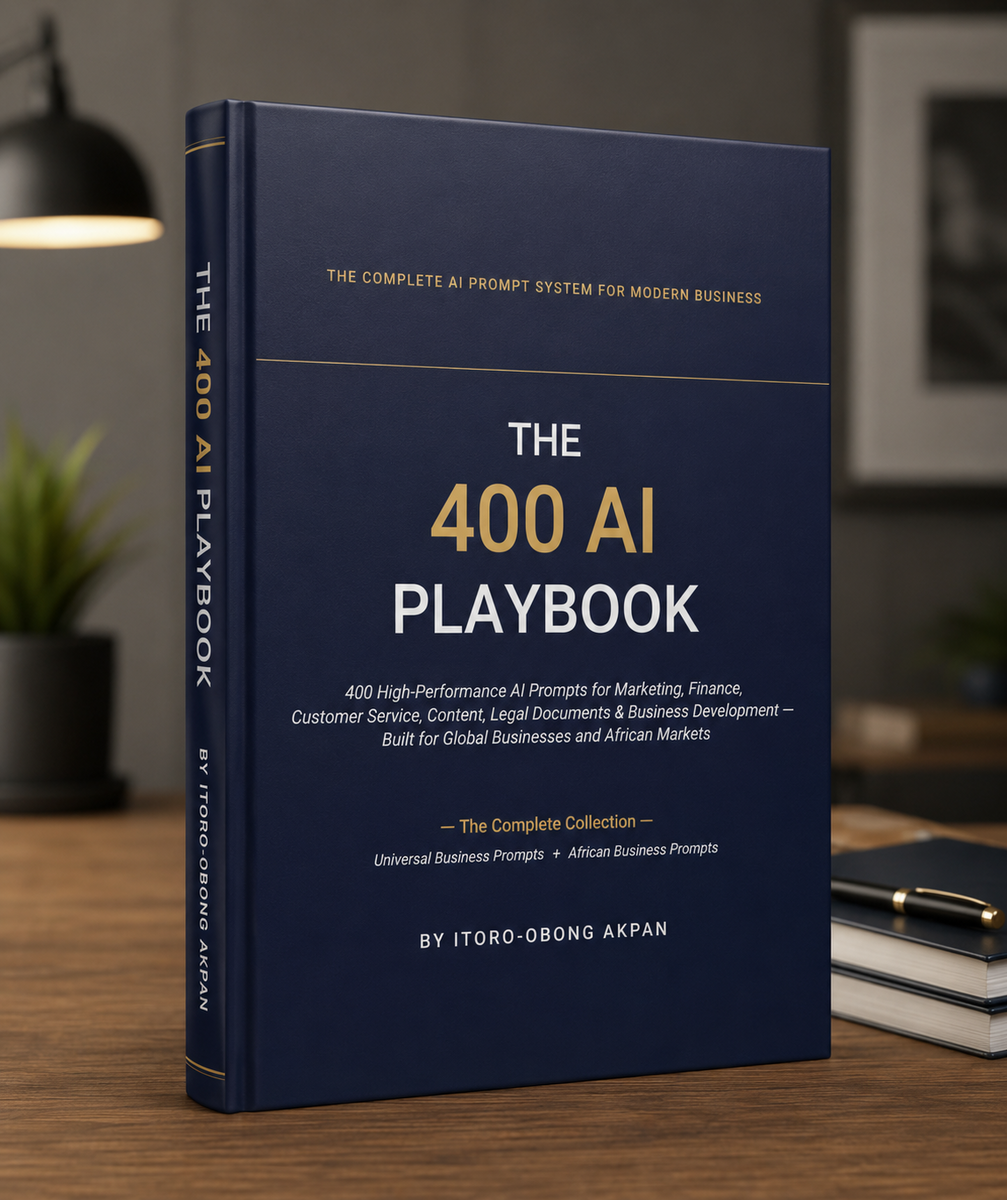
The 400 AI Playbook: The Complete AI Prompt System for Modern Business
400 ready-to-run prompts organised around role, context, objective, inputs, constraints and output format—covering marketing, finance, customer service, content, business documents and business development, plus 200 prompts designed around

About this project
Artificial intelligence has transformed from a futuristic concept into an everyday business necessity. However, many entrepreneurs quickly abandon AI chatbots after receiving generic, unhelpful answers. The flaw isn't the technology; it's the lack of context. Effective AI integration requires moving away from reactive, random questions toward structured, repeatable instructions that define the AI’s role, business context, limitations, and desired output.
The 400 AI Playbook bridges the gap between access and execution. It features 400 high-performance prompts split evenly to address both global and regional business realities:
| Playbook Section | Primary Focus | Key Characteristics l
1.Universal Prompts (200)– Global business operations | Broad applications for freelancers, startups, and agencies worldwide.
2.African Prompts (200)– Localized market realities/Addresses, WhatsApp, commerce, mobile-money, informal markets, and currency fluctuations
SIX CORE BUSINESS APPLICATIONS
The playbook transforms AI from a basic chatbot into a productivity engine across six key operational areas:
1.Marketing:Brainstorming campaigns, analyzing competitors, and structuring marketing angles.
2.Finance:Organizing revenue estimates, pricing strategies, and cash-flow scenarios.
3.Customer Service:Creating reusable response frameworks and support scripts.
4.Content Creation:Drafting blogs, newsletters, and social media captions with specific brand voices.
5.Business Documents:Generating structured first drafts for proposals, reports, and emails.
6.Business Development:Structuring outreach, pitch materials, and partnership opportunities.
BUILDING REPEATABLE WORKFLOWS
AI is a powerful tool, not a standalone business strategy. The ultimate goal of the playbook is not just to provide copy-and-paste questions, but to help businesses build automated, repeatable workflows. By combining human judgment, creativity, and strategic context with AI's processing power, entrepreneurs can turn repetitive tasks into streamlined systems that save time and increase consistency.
Which of these six core business areas do you currently find the most time-consuming to manage in your own workflow?
The 400 AI Playbook bridges the gap between access and execution. It features 400 high-performance prompts split evenly to address both global and regional business realities:
| Playbook Section | Primary Focus | Key Characteristics l
1.Universal Prompts (200)– Global business operations | Broad applications for freelancers, startups, and agencies worldwide.
2.African Prompts (200)– Localized market realities/Addresses, WhatsApp, commerce, mobile-money, informal markets, and currency fluctuations
SIX CORE BUSINESS APPLICATIONS
The playbook transforms AI from a basic chatbot into a productivity engine across six key operational areas:
1.Marketing:Brainstorming campaigns, analyzing competitors, and structuring marketing angles.
2.Finance:Organizing revenue estimates, pricing strategies, and cash-flow scenarios.
3.Customer Service:Creating reusable response frameworks and support scripts.
4.Content Creation:Drafting blogs, newsletters, and social media captions with specific brand voices.
5.Business Documents:Generating structured first drafts for proposals, reports, and emails.
6.Business Development:Structuring outreach, pitch materials, and partnership opportunities.
BUILDING REPEATABLE WORKFLOWS
AI is a powerful tool, not a standalone business strategy. The ultimate goal of the playbook is not just to provide copy-and-paste questions, but to help businesses build automated, repeatable workflows. By combining human judgment, creativity, and strategic context with AI's processing power, entrepreneurs can turn repetitive tasks into streamlined systems that save time and increase consistency.
Which of these six core business areas do you currently find the most time-consuming to manage in your own workflow?